
I received this beautiful classical guitar for my 16th birthday. Yes, that was a long time ago. It’s in such good shape because shortly after that I developed other interests and stopped playing, and it went for a good, long nap in its padded case. But it’s a lovely instrument, so it has stayed with me all this time.
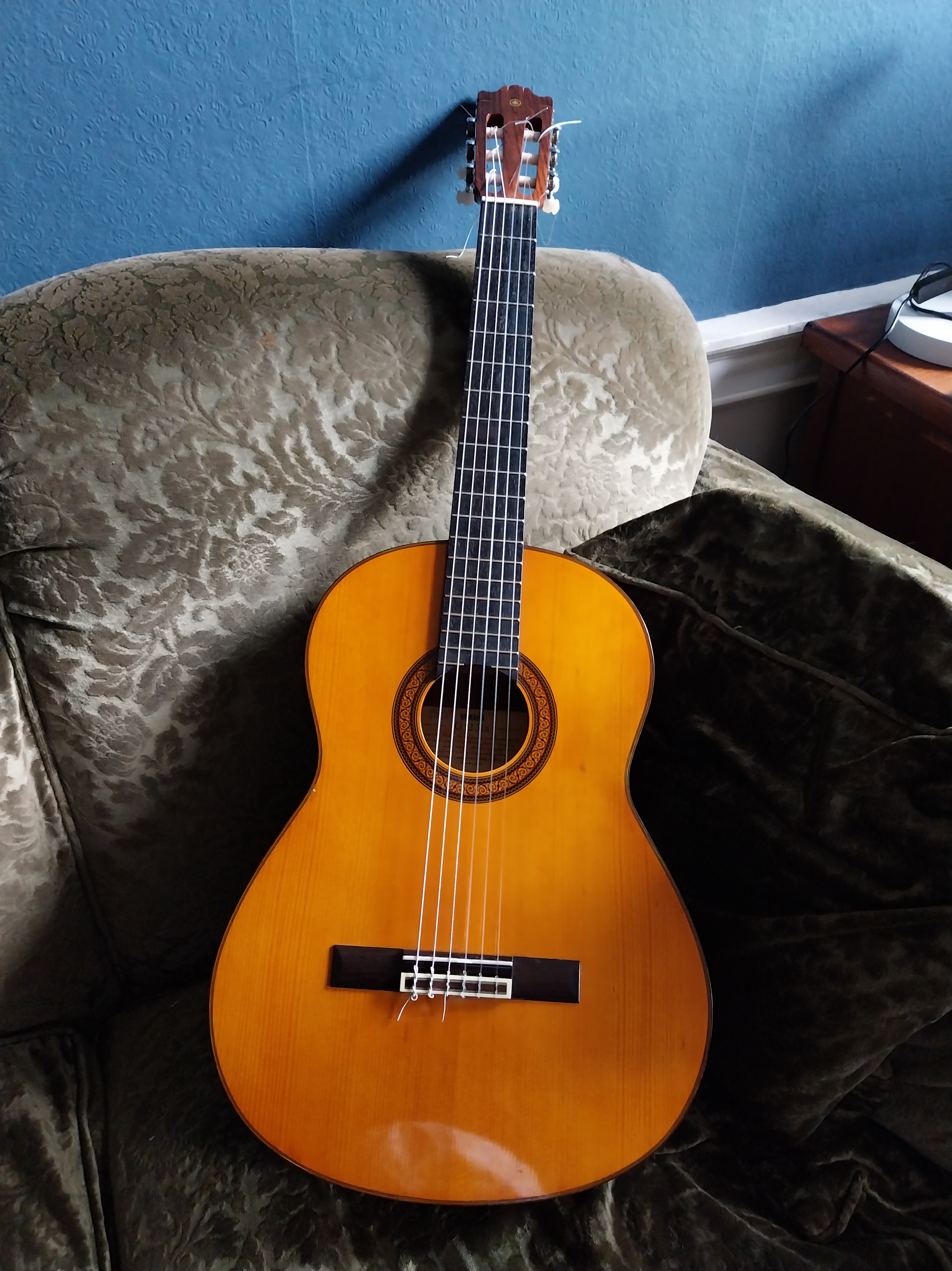
Excuse me. She has informed me that her name is Carmen. I’ve known her for decades but only today learned her name and pronouns.
At any rate, just before Christmas I decided I wanted to pick her back up again, so I signed up for lessons.
As in many things—sewing, languages, fiction writing, sport, music—I’m largely and stubbornly self-taught. Which means that I’ve developed some unique ways of doing things, some of which are better than what a lot of people learn formally, and others which are not quite as efficient or effective. As a result, I’m ahead of my level in some areas, and lagging behind in others. And this means it can be hard to find a learning system that works for me.
I have found an instructor, though, who is happy to meet me where I am, to zoom ahead of the program in areas where I’m ahead, and to help me to smooth out my deficiencies. So yay.
When I went to my first lesson, though, he noted that Carmen’s strings are old.
Well, duh.
A bit embarrassing, though, so time to restring.
I did a bit of reading and found that although I like the sound of steel strings better than that of nylon, nylon strings are better for the guitar itself. So I bought a set of nylon strings and attempted to give Carmen an update.
Success, except for the second and fifth strings. I couldn’t get the old ones out. After a bit of exploration, I diagnosed the problem as this little f*cker right here.

Inside the plastic tubes of the machine head, there are metal posts. The hole goes through both the metal and the plastic, but for some reason (hmmm maybe steel strings left on a classical guitar for a few decades? Sorry, Carmen) the plastic had slipped so that the holes were no longer aligned. I fixed the problem on string two, but string five wouldn’t budge.
This is where I go on a bit about YouTube. You know, you can learn anything there. It’s not all jackass stunts and conspiracy theorists. I learned how a machine head is put together—it’s pretty simple and they’re very easy to change out.
In theory.

Errr…
Over time, the autodidact learns a few important rules:
- Don’t force it. Ever.
- Do your freakin’ research before starting.
- Work incrementally, from more conservative to less conservative measures.
- Avoid, if at all possible, doing anything you can’t take back.
- Have a professional picked out in case things go sideways.
So, for example, if the machine head had been glued on (eek!) I’d have resisted the urge to take a breadknife to it, and brought Carmen to someone who knew what they were doing. Fortunately, it wasn’t. And it came off just as easily for me as for the chap on YouTube.

I addressed the misalignment with a gentle twist of pliers, then used the same to carefully remove the ends of the stuck strings. Then I screwed the machine head back onto the guitar and restrung her.
It sounds easy, but I was sweating the entire time. I had visions of having to take Carmen to a repair shop, in bits, and having some smug gearhead tell me they could have helped if I hadn’t attempted the job myself and ruined everything. Or that yes, you can change the tuner on a brand new expensive guitar, but not on a 40-year-old budget model. Or that they can absolutely help, but it will cost several hundred quid and not be ready for a month.
And that I’d have to cancel my next lesson while admitting my spectacular hubris and its cataclysmic results to my instructor who, at least to this point, hadn’t considered me a complete nitwit.
But it went smoothly. I addressed the problem. I restrung the guitar. I tuned the guitar. I played the guitar.
And I learned a boatload of new mechanical skills, which makes me feel pretty accomplished.
At some point in the near future, I’m going to treat Carmen to a good cleaning and a new, high quality machine head. But for now I think I’ll get on with those arpeggios.
Music is an art. So is writing. Would you like to check out my books? You can do so here.
 Jess Faraday